TechnoEdge

Free Master Class

How to Plan Your AI Training Budget for FY26? (For CHROs & L&Ds)

generative AI training

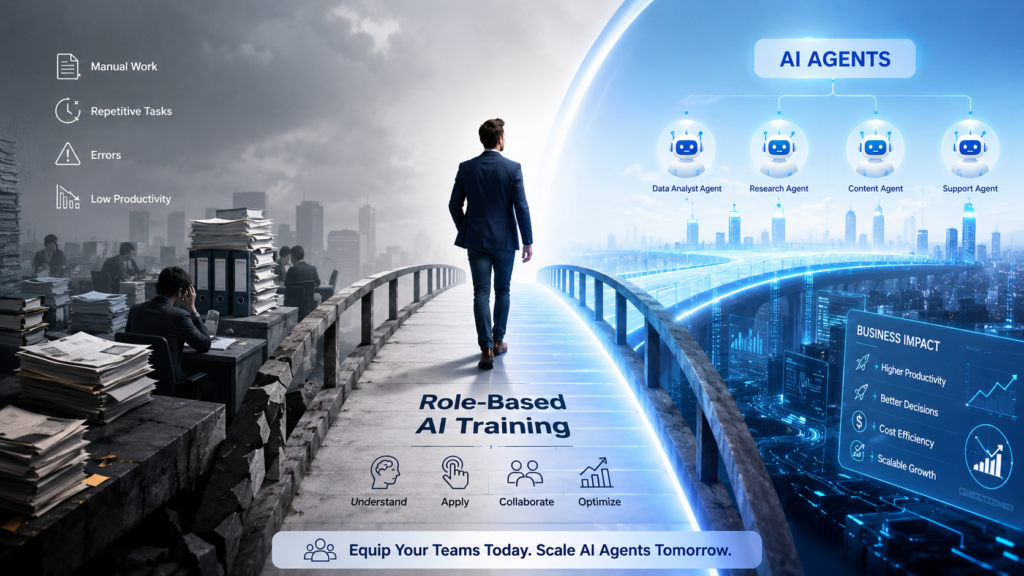
Role-based agentic AI training for business teams moving from manual work to AI agents
blogs

Agentic AI for Business Teams in 2026: Why Enterprises Need Role-Based Training Before AI Agents Scale

AI agents are no longer just experimental tools inside innovation labs. In 2026, they are entering business workflows, customer operations, analytics systems, IT service desks, finance processes, HR platforms, and enterprise automation pipelines. For years, enterprise AI was mainly used to assist decisions. Business users asked questions. AI generated summaries. Analysts used dashboards. Managers reviewed recommendations. Human teams remained firmly in control of the workflow. That model is changing. Agentic AI introduces a more serious enterprise shift. Instead of only answering questions, AI agents can plan tasks, use tools, trigger actions, interact with systems, and complete multi-step workflows with varying levels of autonomy. This is not just another chatbot upgrade. It is a structural change in how work moves through an organization. The companies that treat agentic AI as a software rollout will struggle. The companies that treat it as a workforce capability shift will be better prepared to scale it safely, productively, and profitably. 2026 Disruption: AI Agents Are Moving from Assistants to Actors The 2026 disruption is clear. Enterprises are moving from AI that informs employees to AI that acts on behalf of employees. Microsoft describes Copilot Studio as a SaaS agent platform that helps organizations build AI agents and agentic workflows for business processes, with managed security, governance, and operations capabilities for enterprise scale. This changes the training requirement. A business user who worked with Generative AI in 2024 may only have needed prompt clarity, output review, and basic AI awareness. In 2026, the same user may need to understand what an AI agent is allowed to do, when human approval is required, how enterprise data is accessed, how actions are logged, and how errors are escalated. Deloitte’s 2026 State of AI in the Enterprise research shows why this matters. In a survey of 3,235 IT and business leaders across 24 countries, only 21 percent said their organizations had a mature governance model for agentic AI, while 74 percent expected their companies to use AI agents at least moderately by 2027. That gap is the real enterprise risk. The issue is not whether business teams will use AI agents. They will. The issue is whether they will use them with enough role clarity, governance awareness, process discipline, and business judgment to produce measurable value instead of operational confusion. What This Blog Covers In this blog, you will learn: The Big Shift in One View AI answered questions↓AI agents execute workflows↓Teams must direct and validate agents↓Untrained users create risk and weak ROI↓Role-based training becomes mandatory before scale 1. Agentic AI Is Not Another Chatbot Upgrade Agentic AI changes the operating model. A chatbot responds to a question. A Generative AI tool produces content. An AI agent can pursue a goal across multiple steps, use enterprise tools, make intermediate decisions, and trigger actions inside a workflow. That distinction matters because business risk increases when AI moves from response to execution. When AI summarizes a document incorrectly, the damage may be limited if a human reviews it. When an AI agent updates a CRM record, sends a supplier email, approves a workflow, escalates a ticket, changes a project status, or triggers a data pipeline, the organization is no longer dealing with content quality alone. It is dealing with process control. IBM describes this shift clearly: agentic AI moves enterprise AI from insight to execution, which demands new standards for governance, accountability, and control. The governance focus must move from validating answers to controlling actions. This is why enterprise leaders cannot treat agentic AI training as a generic AI awareness session. The finance team does not need the same training as the IT team. HR does not need the same operating model as customer support. Sales teams do not face the same governance risks as data engineering teams. Role-based training is the bridge between AI agent capability and safe enterprise adoption. 2. Why 2026 Makes Role-Based Agentic AI Training Urgent The timing is important. In earlier stages of AI adoption, many organizations could afford to experiment. Teams used ChatGPT, Copilot, Gemini, or internal AI tools for productivity. Leaders encouraged pilots. Innovation teams tested use cases. Risk remained manageable because most AI outputs still required human action. That window is narrowing. Microsoft’s Build 2026 messaging highlights secure, governed, extensible foundations for AI agents across platforms such as Copilot Studio, Agent 365, Azure DevOps, and Model Context Protocol. The direction is clear: enterprise AI is moving toward agent creation, governance, adoption, support, and measurable outcomes at scale. This creates pressure on business teams. Employees who only understand “how to prompt AI” may not understand how to supervise an AI agent. Managers who only understand AI productivity may not understand agent accountability. Department heads who only approve use cases may not know how to define autonomy levels, escalation rules, data boundaries, and success metrics. However, the solution is not to slow down adoption indefinitely. The right response is structured enablement. Enterprises need to train employees before agents become deeply embedded in daily workflows. That training must be practical, role-specific, and connected to the tools employees already use, such as Microsoft 365 Copilot, Copilot Studio, Power BI, Microsoft Fabric, Azure AI, CRM platforms, HR systems, ticketing systems, and workflow automation platforms. 3. The Enterprise Risk: Scaling Agents Before Skills The biggest risk is not that AI agents fail publicly. The bigger risk is that they fail quietly inside business processes. An AI agent can make a wrong assumption, use outdated data, trigger an unnecessary escalation, reveal sensitive information, create inconsistent customer responses, or complete a task without enough human review. Deloitte warns that without proper monitoring and central control, AI agents can make unseen mistakes, work at cross purposes, expose sensitive information, invite cyberattacks, and create compounded risks as pilots move to full production. This is not a technology-only problem. It is a people, process, and governance problem. If business teams do not understand how agents work, they cannot define safe boundaries. If managers do not know what to monitor, they cannot measure performance.
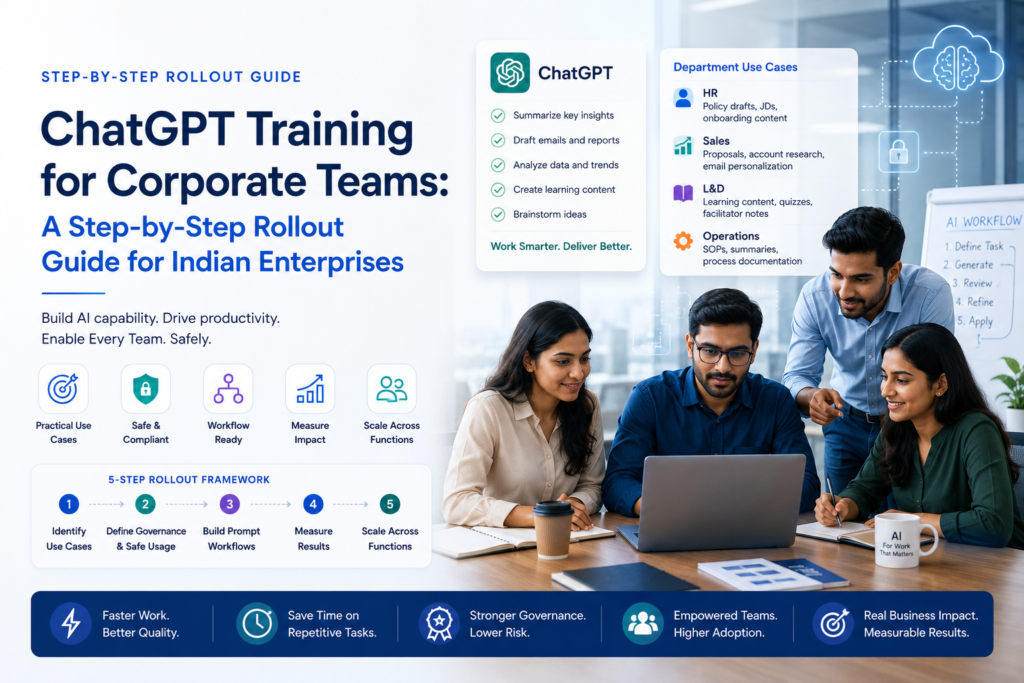
Corporate team planning a ChatGPT training rollout for an Indian enterprise.
blogs

ChatGPT Training for Corporate Teams: A Step-by-Step Rollout Guide for Indian Enterprises

Indian enterprises are moving past the “should we use AI?” stage and into the harder question: how do we use it safely, consistently, and with measurable business value? That is why chatgpt training for teams has become a practical capability-building priority, not just a technology experiment. For HR, L&D, sales, operations, and support teams, the real challenge is not access to AI tools. It is turning those tools into repeatable workflows that improve speed, quality, and decision-making without creating privacy, compliance, or quality risks. That is where structured ai tools training for workforce becomes essential. Why chatgpt training for teams matters in 2026 In 2026, AI is no longer a side topic in corporate learning. It is becoming part of everyday work across writing, analysis, ideation, summarization, and internal communication. Teams that know how to use ChatGPT well can move faster, but only if they understand where it helps, where it fails, and how to use it responsibly. For Indian enterprises, this matters even more because use cases are often distributed across functions. A sales team may need proposal support, an L&D team may need content drafts, HR may need policy communication assistance, and operations may need process documentation. Without structured training, employees tend to use AI inconsistently, which reduces output quality and increases risk. The strongest training programmes focus on practical use, not abstract AI theory. They help people learn how to ask better questions, review outputs critically, and apply the tool to real work. Common mistakes in ai tools training for workforce Many enterprises begin AI training with excitement but no rollout discipline. The result is usually awareness without adoption, or experimentation without control. Common mistakes include: Another common issue is overestimating what employees can safely do on day one. If teams are not shown clear boundaries, they may paste sensitive information into public tools or rely too heavily on generated outputs without review. Good training reduces this risk by making safe use part of the learning design. Step 1: identify department-specific AI use cases The first rollout step is to identify where ChatGPT can create the most value in each function. A single enterprise-wide use case list is usually too broad to drive adoption. Start by asking each department where time is spent on repetitive, text-heavy, or research-supported work. For example: The goal is not to automate everything. The goal is to find the tasks where AI can save time, improve consistency, or help teams start faster. Step 2: define governance, data privacy, and acceptable usage Once use cases are clear, governance must come next. Enterprises need rules for what employees can and cannot enter into AI tools, how outputs should be reviewed, and where human approval is mandatory. A practical governance framework should cover: This is especially important in regulated sectors and in organisations handling customer, employee, financial, or proprietary data. Training should not just explain policy in theory; it should show employees how the policy affects day-to-day work. Step 3: build prompt workflows for HR, sales, L&D, and operations Prompting works best when it is connected to a workflow, not treated as a standalone skill. Employees should learn prompt patterns that map to their actual tasks, review steps, and expected output formats. For HR, a prompt workflow may include drafting, refinement, and compliance review. For sales, it may include research, personalization, proposal structure, and final human editing. For L&D, the workflow may include content creation, simplification, knowledge checks, and learner-level adaptation. A useful training approach is to create: This makes training more practical and easier to retain because people learn by doing work they already recognise. Step 4: measure productivity and output quality If the enterprise cannot measure results, AI training will remain a feel-good initiative. Measurement should look at both productivity and quality, because speed alone can create poor outputs. Useful metrics include: It also helps to compare outputs before and after training on real business tasks. For example, measure how long it takes to create a client email, a training outline, or an internal memo before the rollout and after employees begin using ChatGPT with a workflow. Step 5: scale chatgpt training for teams across business functions Scaling should happen after pilot groups prove value and governance is stable. The best programmes begin with a few functions, refine the content, and then expand into other teams. A scalable rollout usually includes: This is also where leadership support matters. When managers show what good AI-assisted work looks like, adoption becomes much stronger than when training is left only to the L&D team. How Technoedge helps with AI readiness, use-case-based ChatGPT training, workflow-oriented prompting, safe adoption practices, and business team enablement Technoedge helps enterprises move from AI awareness to structured adoption. That starts with identifying the highest-value use cases by function, so training is relevant to the work teams actually do. From there, we design learning journeys that combine practical prompting, governance awareness, and workflow application. We also support safe adoption by helping organisations define boundaries, review practices, and department-level use scenarios that reduce risk. Our delivery approach focuses on business enablement, not just skill transfer. That means teams learn how to use ChatGPT in ways that improve speed, quality, and consistency in daily work. For enterprises exploring chatgpt training for teams, the biggest challenge is usually turning generic AI enthusiasm into safe, useful workflows. Technoedge can help shape that journey through role-specific training, practical prompts, and adoption frameworks that support everyday work without adding complexity. FAQs 1. ChatGPT training for teams: what should be included in a corporate rollout plan? A corporate rollout plan should include use-case discovery, governance rules, department-wise learning paths, prompt practice, and measurement. It should also include leadership alignment so the training is seen as a business capability initiative rather than a one-time workshop. The rollout plan works best when it balances speed and control. That means employees get enough freedom to explore value, but also enough structure to protect data, quality, and compliance. 2. AI tools training for workforce: which departments benefit

Trust Us, One Call Can Make a Difference
[wpforms id="8948"]
Join As Trainer
Join As Trainer
[wpforms id="5252"]
Download Course Content
[wpforms id="10817"]
[wpforms id="10817"]
Scroll to Top