TechnoEdge

Free Master Class

How to Plan Your AI Training Budget for FY26? (For CHROs & L&Ds)

data-driven L&D

L&D leaders planning 2027 corporate training strategy with AI, GenAI, microlearning, and leadership development priorities.
blogs

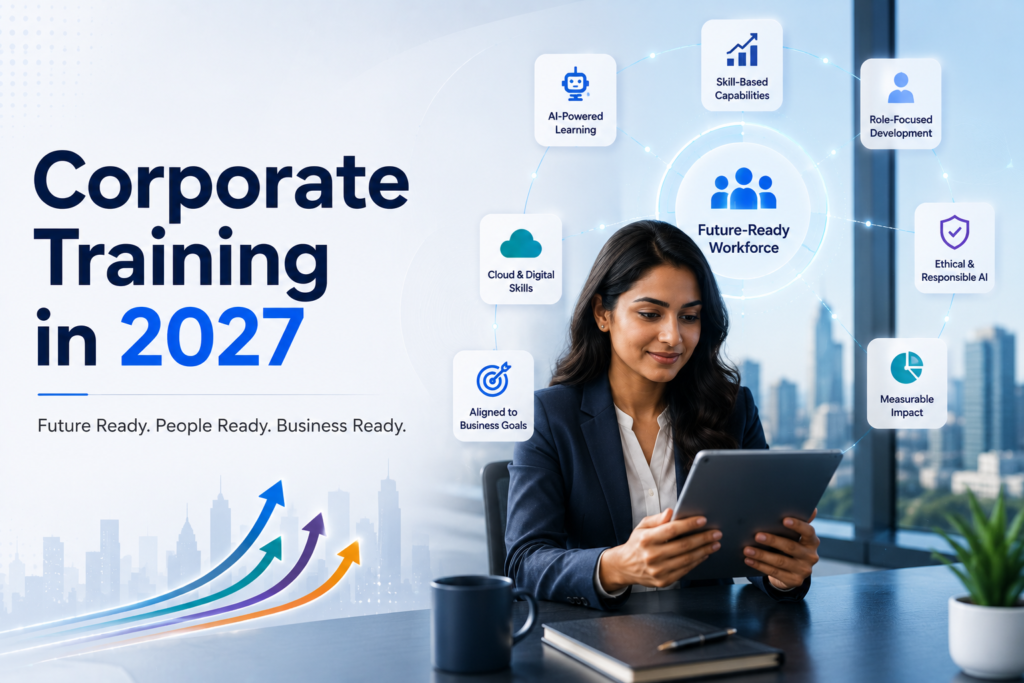
What Will Corporate Training Look Like in India by 2027? Trends, Predictions & What to Do Now

By 2027, corporate training in India will look fundamentally different from today. The shift is already visible: Indian enterprises in IT, BFSI, manufacturing, and GCCs are moving from generic, event-based training to structured, outcome-linked capability building. The focus is no longer just on “delivering sessions” but on building workforce readiness for AI, cloud, automation, and role-specific digital skills. For CHROs, L&D leaders, and business heads, the question is not whether corporate training will change, but how to prepare now. Organisations that invest in AI tools training for workforce, role-based academies, and business-linked learning models will outperform those that continue with the old model. At Technoedge, we are designing enterprise training programmes that anticipate these 2027 shifts—focusing on future-ready capability building, AI-enabled learning, and role-based design aligned with changing business demands. Why the corporate training model is changing in India The traditional corporate training model in India—off-the-shelf courses, one-day workshops, and generic soft skills programmes—is losing relevance. Several forces are driving this change: 1. Business priorities are evolving faster Enterprises are prioritising cloud migration, AI adoption, digital transformation, and automation. Training must now support these strategic shifts, not just general capability building. 2. Technology is changing the nature of work AI, automation, and cloud tools are reshaping how employees work. AI tools training for workforce is no longer optional; it is a baseline requirement for productivity. 3. Buyers are more demanding CHROs, L&D heads, and business leaders now expect training to show measurable outcomes, not just completion rates. They want to see ROI tied to business goals. 4. Internal capability systems are emerging Many organisations are building internal academies, communities of practice, and role-based learning paths rather than relying solely on external vendors. 5. Corporate training companies India are differentiating Providers are splitting into specialised categories: custom learning partners, technical upskilling specialists, leadership brands, and platform-led digital skills providers. Buying decisions are more nuanced. The result is a training market that rewards providers who can deliver business-relevant, measurable, and scalable capability building. AI tools training for workforce as a mainstream priority By 2027, AI tools training for workforce will be as mainstream as Microsoft 365 or email training is today. Every enterprise will need to prepare employees to use AI responsibly and effectively. What will change by 2027 What organisations need to do now Organisations that act early will see faster productivity gains and better adoption. Skill-based capability building and role-based academies By 2027, the most effective enterprises will move from “training programmes” to “capability systems” built around roles and skills. What this looks like Benefits What usually goes wrong What good looks like is role-based academies grounded in validated skill frameworks and business priorities. Outcome measurement and business-linked learning models By 2027, enterprise buyers will expect training to demonstrate clear business impact, not just learning completion. How measurement will evolve What buyers will demand Corporate training providers that cannot demonstrate outcomes will lose to those that can. Hybrid delivery, project-based learning, and internal capability systems The delivery model for corporate training will continue to evolve toward hybrid, project-based, and internally supported systems. Hybrid delivery Project-based learning Internal capability systems By 2027, the most successful organisations will combine external expertise with internal capability systems for sustained learning. What corporate training companies in India need to do differently Corporate training companies India that continue with the old model—generic courses, feature-focused training, and one-size-fits-all delivery—will struggle. Buyers will increasingly choose providers who can demonstrate: 1. Specialization 2. Customization 3. Outcome linkage 4. Scalable delivery 5. Partnership mindset Providers that embrace these shifts will win more enterprise business. How Technoedge helps with future-ready capability building, AI-enabled workforce training, role-based learning design, and enterprise training programs aligned with changing business demands At Technoedge, we are building enterprise training programmes that anticipate 2027 shifts, not just respond to current demand. Our approach includes: 1. Future-ready capability building 2. AI-enabled workforce training 3. Role-based learning design 4. Enterprise training programs aligned with business demands This ensures organisations are prepared for 2027 and beyond. FAQs 1. Corporate training companies India: what trends will shape corporate training by 2027? Key trends include AI tools training for workforce becoming mainstream, role-based academies and skill frameworks, outcome measurement and business-linked learning models, hybrid delivery and project-based learning, and internal capability systems. Corporate training companies India will need to specialise, customise, and demonstrate ROI. 2. AI tools training for workforce: how will AI change enterprise learning in India? AI will change enterprise learning by making AI literacy a baseline requirement, introducing function-specific AI use cases, embedding prompt engineering as a core skill, including ethics and governance, and using AI to personalise learning paths and support coaching. 3. Corporate learning strategy India: what should organizations start doing now for 2027 readiness? Organisations should start with AI literacy programmes, build role-based competency frameworks, design learning paths aligned to business priorities, invest in measurement and outcome tracking, and begin building internal capability systems like academies and communities of practice. 4. Corporate training companies India: how will enterprise buyers evaluate training partners in the future? Enterprise buyers will evaluate training partners based on specialization, customization depth, delivery quality, outcome linkage, scalability, and partnership mindset. Providers that can demonstrate business impact will win over those that only offer generic training. 5. Workforce upskilling plan: how should companies prepare for future skill shifts? Companies should build adaptable capability systems rather than isolated programmes, prioritise critical roles and skills, invest in AI and cloud readiness, create role-based learning paths, and measure capability maturity over time. Connect with us For organizations planning beyond immediate training needs, future readiness depends on building adaptable capability systems rather than isolated programs. Technoedge can help support that shift through learning strategies and enterprise training interventions designed around emerging workforce priorities. To explore how this can work for your context, you can connect with Technoedge at: https://technoedgelearning.com

L&D analytics, learning analytics, training ROI, prove training impact, L&D metrics,
blogs

L&D Analytics: Proving Training ROI to Leadership

For years, L&D teams survived on “completion rates” and “smile sheets.” In 2026, that’s not enough anymore. Leadership wants to know one thing: “If we spend this money on training, what do we get back?” Right now, only about 15% of L&D leaders can clearly show the business impact of their programs. The ones who can are seeing up to 3x higher returns than those flying blind.​ Corporate learning analytics has changed the game. Modern teams connect training data with real business metrics like sales uplift, defect reduction, promotion speed, and reduced turnover. A semiconductor company reduced defect rates by 3.2% and saved $2.4 million per year from a single advanced process training program, off a $180,000 investment a 1,233% ROI. When leaders search “how to justify L&D budget” on Google or ask AI tools how to prove training value, the answer is the same: stop reporting activity and start reporting impact.​ Why Traditional L&D Metrics Don’t Convince Leadership Activity Metrics vs Business Impact Most L&D dashboards still focus on activity metrics: These numbers answer “Did people take the training?” but not “Did anything change because of it?”. Executives care about performance, not participation. Only 15% of L&D teams can demonstrate clear business impact, yet organizations that master L&D ROI measurement achieve three times higher returns than those that don’t.​ L&D has long relied on vague statements like “engagement improved” or “employees enjoyed the program.” In a data-driven world, those answers no longer work. Finance, sales, and operations all show impact in hard numbers. Learning teams must do the same. The Cost of Flying Blind When L&D can’t show impact, budgets get frozen or cut first during tough times. Programs get labeled “nice to have” instead of essential for growth. Strategic initiatives like leadership development, onboarding revamps, or AI upskilling struggle to get funding, even though data shows they directly affect retention, productivity, and revenue.​ Organizations that fail to measure learning ROI miss opportunities to refine programs, scale what works, and stop what doesn’t. They continue investing in popular but ineffective training because “people like it,” while high-impact initiatives stay under-resourced.​ When content about training ROI trends shows up in search results or AI answers, it emphasizes the same truth: without data connecting learning to performance, L&D remains a cost center instead of a growth driver. What Modern L&D Analytics Looks Like in 2026 From LMS Reports to Integrated Data Ecosystems Learning analytics in 2026 goes far beyond LMS exports. Mature organizations build a “single source of truth” that integrates:​ Deloitte calls this integrated learning–business data layer the foundation that lets L&D talk about workforce strategy, not just course catalogs. When training outcomes are directly visible next to revenue numbers, defect rates, or customer satisfaction scores, leadership pays attention.​ Modern tech stack components include: These tools feed into analytics dashboards built for executives, not just learning teams. AI-Enhanced Insight, Not Just Reports In the GenAI age, analytics moves from “What happened?” to “What should we do next?”. AI-driven learning analytics can:​ Instead of quarterly static reports, L&D gains real-time insight into training effectiveness and skill progression. For example, AI can reveal that learners who complete a particular microlearning path close deals 12% faster or that teams whose managers finished coaching training have 15–22% productivity gains compared to 3–5% without programs.​ These insights transform L&D from reactive support function into strategic advisor. The Metrics That Actually Matter Core Business-Linked Training Metrics Beyond completions and attendance, modern L&D teams track metrics tied directly to business outcomes:​ For example, a semiconductor manufacturer saw a 3.2% defect reduction after advanced process training, saving $2.4M annually – 1,233% ROI on a $180K program. A leadership program boosted retention from 67% to 89%, cut average turnover costs from $41K to $18K, and improved productivity 15–22% vs only 3–5% in groups without development.​ Portfolio Health Indicators Daily L&D operations still need foundational metrics, but used with purpose:​ These help manage the learning portfolio efficiently while you tie key programs to business metrics. Customized Experience Metrics Generic metrics can’t capture how learners actually experience training. Advanced teams design custom analytics that track: These insights allow teams to optimize specific modules, not just whole courses. If 65% of learners drop at slide 12, you know exactly where to look. How to Link Learning to Business Outcomes Start With the Business Problem, Not the Course Idea High-impact analytics begins before training is even designed. Instead of “We need a time management course,” conversations shift to: Once the business problem is defined, L&D clarifies: These KPIs become the anchor metrics for your ROI story. Build Data Connections Before Launch Many teams try to prove impact after training finishes, then realize they never set baselines or control groups. Modern practice sets measurement plans upfront:​ For example, to measure sales training impact: This structure lets you isolate training effect from other factors better than generic before–after comparisons. Use Layered Evidence, Not Just One Number Strong ROI stories blend multiple evidence types: For leadership development, for example: This multi-layer approach respects that human development has complex, time-based effects, while still giving finance-friendly proof points. Tools and Technology That Make It Possible Modern Learning Systems With Analytics Built-In LMS and LXP platforms in 2026 embed analytics capabilities that go far beyond basic reports:​ Skills management platforms show where competencies sit across the organization and how they shift after interventions. VR/AR systems log detailed performance data during simulations, showing readiness for high-risk tasks without real-world consequences.​ BI and Data Warehouses Many organizations now pipe learning data into central BI tools (Power BI, Tableau, Looker) alongside finance and operations metrics. This allows unified dashboards where an executive can see:​ In other words: L&D data becomes part of the same conversation as revenue and cost. AI and GenAI for Deeper Insight AI helps L&D in several ways:​ In the GenAI age, the challenge isn’t lack of data – it’s asking the right questions and translating insights into decisions. Turning Analytics Into Budget and Influence Reporting That Executives

Trust Us, One Call Can Make a Difference
[wpforms id="8948"]
Join As Trainer
Join As Trainer
[wpforms id="5252"]
Download Course Content
[wpforms id="10817"]
[wpforms id="10817"]
Scroll to Top