TechnoEdge

Free Master Class

How to Plan Your AI Training Budget for FY26? (For CHROs & L&Ds)

continuous learning

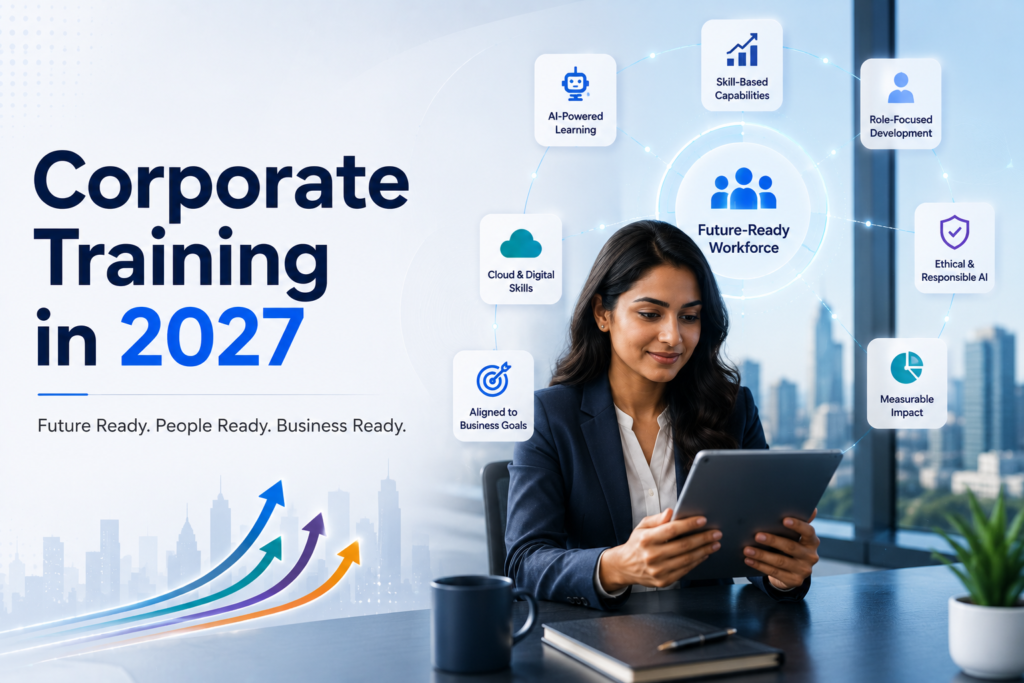
L&D leaders planning 2027 corporate training strategy with AI, GenAI, microlearning, and leadership development priorities.
blogs

What Will Corporate Training Look Like in India by 2027? Trends, Predictions & What to Do Now

By 2027, corporate training in India will look fundamentally different from today. The shift is already visible: Indian enterprises in IT, BFSI, manufacturing, and GCCs are moving from generic, event-based training to structured, outcome-linked capability building. The focus is no longer just on “delivering sessions” but on building workforce readiness for AI, cloud, automation, and role-specific digital skills. For CHROs, L&D leaders, and business heads, the question is not whether corporate training will change, but how to prepare now. Organisations that invest in AI tools training for workforce, role-based academies, and business-linked learning models will outperform those that continue with the old model. At Technoedge, we are designing enterprise training programmes that anticipate these 2027 shifts—focusing on future-ready capability building, AI-enabled learning, and role-based design aligned with changing business demands. Why the corporate training model is changing in India The traditional corporate training model in India—off-the-shelf courses, one-day workshops, and generic soft skills programmes—is losing relevance. Several forces are driving this change: 1. Business priorities are evolving faster Enterprises are prioritising cloud migration, AI adoption, digital transformation, and automation. Training must now support these strategic shifts, not just general capability building. 2. Technology is changing the nature of work AI, automation, and cloud tools are reshaping how employees work. AI tools training for workforce is no longer optional; it is a baseline requirement for productivity. 3. Buyers are more demanding CHROs, L&D heads, and business leaders now expect training to show measurable outcomes, not just completion rates. They want to see ROI tied to business goals. 4. Internal capability systems are emerging Many organisations are building internal academies, communities of practice, and role-based learning paths rather than relying solely on external vendors. 5. Corporate training companies India are differentiating Providers are splitting into specialised categories: custom learning partners, technical upskilling specialists, leadership brands, and platform-led digital skills providers. Buying decisions are more nuanced. The result is a training market that rewards providers who can deliver business-relevant, measurable, and scalable capability building. AI tools training for workforce as a mainstream priority By 2027, AI tools training for workforce will be as mainstream as Microsoft 365 or email training is today. Every enterprise will need to prepare employees to use AI responsibly and effectively. What will change by 2027 What organisations need to do now Organisations that act early will see faster productivity gains and better adoption. Skill-based capability building and role-based academies By 2027, the most effective enterprises will move from “training programmes” to “capability systems” built around roles and skills. What this looks like Benefits What usually goes wrong What good looks like is role-based academies grounded in validated skill frameworks and business priorities. Outcome measurement and business-linked learning models By 2027, enterprise buyers will expect training to demonstrate clear business impact, not just learning completion. How measurement will evolve What buyers will demand Corporate training providers that cannot demonstrate outcomes will lose to those that can. Hybrid delivery, project-based learning, and internal capability systems The delivery model for corporate training will continue to evolve toward hybrid, project-based, and internally supported systems. Hybrid delivery Project-based learning Internal capability systems By 2027, the most successful organisations will combine external expertise with internal capability systems for sustained learning. What corporate training companies in India need to do differently Corporate training companies India that continue with the old model—generic courses, feature-focused training, and one-size-fits-all delivery—will struggle. Buyers will increasingly choose providers who can demonstrate: 1. Specialization 2. Customization 3. Outcome linkage 4. Scalable delivery 5. Partnership mindset Providers that embrace these shifts will win more enterprise business. How Technoedge helps with future-ready capability building, AI-enabled workforce training, role-based learning design, and enterprise training programs aligned with changing business demands At Technoedge, we are building enterprise training programmes that anticipate 2027 shifts, not just respond to current demand. Our approach includes: 1. Future-ready capability building 2. AI-enabled workforce training 3. Role-based learning design 4. Enterprise training programs aligned with business demands This ensures organisations are prepared for 2027 and beyond. FAQs 1. Corporate training companies India: what trends will shape corporate training by 2027? Key trends include AI tools training for workforce becoming mainstream, role-based academies and skill frameworks, outcome measurement and business-linked learning models, hybrid delivery and project-based learning, and internal capability systems. Corporate training companies India will need to specialise, customise, and demonstrate ROI. 2. AI tools training for workforce: how will AI change enterprise learning in India? AI will change enterprise learning by making AI literacy a baseline requirement, introducing function-specific AI use cases, embedding prompt engineering as a core skill, including ethics and governance, and using AI to personalise learning paths and support coaching. 3. Corporate learning strategy India: what should organizations start doing now for 2027 readiness? Organisations should start with AI literacy programmes, build role-based competency frameworks, design learning paths aligned to business priorities, invest in measurement and outcome tracking, and begin building internal capability systems like academies and communities of practice. 4. Corporate training companies India: how will enterprise buyers evaluate training partners in the future? Enterprise buyers will evaluate training partners based on specialization, customization depth, delivery quality, outcome linkage, scalability, and partnership mindset. Providers that can demonstrate business impact will win over those that only offer generic training. 5. Workforce upskilling plan: how should companies prepare for future skill shifts? Companies should build adaptable capability systems rather than isolated programmes, prioritise critical roles and skills, invest in AI and cloud readiness, create role-based learning paths, and measure capability maturity over time. Connect with us For organizations planning beyond immediate training needs, future readiness depends on building adaptable capability systems rather than isolated programs. Technoedge can help support that shift through learning strategies and enterprise training interventions designed around emerging workforce priorities. To explore how this can work for your context, you can connect with Technoedge at: https://technoedgelearning.com
learning culture, continuous learning, future-ready workforce, workplace learning
blogs

Learning Culture & Continuous Learning: How Future-Ready Companies Think About L&D

Static skill sets don’t survive in a world where technologies, markets, and customer expectations shift every quarter. That’s why organizations are moving from “once-a-year training” to continuous learning cultures where development is part of how work gets done, not an interruption from it. Deloitte’s Human Capital research shows companies with strong learning cultures are 92% more likely to innovate, 56% more likely to be first to market, and 52% more productive. LinkedIn data indicates such companies can achieve 2x higher employee retention than those with weak or ad hoc learning environments.​ In a tight talent market where 90% of organizations worry about retention, learning opportunities now rank as the #1 strategy employers use to keep their best people. At the same time, 94% of employees say they would stay longer at a company that invests in their learning and development. The message is clear: future-ready organizations treat learning culture as a core business system, not a perk.​ Why continuous learning matters more than ever Skills have a shrinking shelf life Skills now have an average shelf life of about five years, with many digital skills becoming outdated even faster. Without continuous upskilling and reskilling, teams fall behind on new tools, processes, and customer expectations. Continuous learning keeps employees adaptable and capable of handling more responsibilities, improving performance and resilience in volatile environments.​ Continuous learning helps organizations maintain competitiveness by expanding employee skills, increasing knowledge retention, and generating new ideas. It supports a forward-looking, innovation-driven culture and keeps costs down because it’s cheaper to develop current employees than constantly recruit and ramp new ones.​ Learning opportunities drive engagement and retention Learning is now one of the strongest engagement levers. Continuous learning opportunities are a top driver of employee engagement, second only to compensation in many surveys. Engaged employees are 17% more productive and teams in highly engaged organizations are 21% more profitable.​ Companies with moderate learning cultures see retention around 27%, whereas those with strong learning cultures see retention at 57% more than double. In parallel, 94% of employees say they’d stay longer at organizations that invest in their development. Continuous learning fulfills employees’ desire for growth, creates visible career paths, and directly reduces turnover costs.​ What a learning culture actually looks like Learning is embedded in everyday work A genuine learning culture goes beyond offering a catalog of courses. It creates an environment where employees are encouraged and expected to: Learning-centric workplaces provide centralized knowledge hubs accessible 24/7, social learning spaces where employees can ask questions and exchange ideas, and performance support tools that help people apply skills on the job. The organization signals that learning is part of the job, not something you do “if you have time.”​ Leadership models and rewards learning behavior Learning cultures start at the top. Leaders in these organizations actively model continuous learning by taking courses, attending workshops, asking questions, and sharing what they’re learning. They talk about development in town halls, tie learning to strategy, and make space for experimentation and reflection.​ Organizations that successfully build learning cultures also recognize and reward learning behaviors completing development plans, sharing expertise, mentoring others, and applying new skills to improve work. Promotions and internal mobility decisions consider not just current performance but also learning agility and development contributions. This signals that growing is just as important as knowing.​ Business impact of a strong learning culture Retention, engagement, and internal mobility Companies with a strong learning culture have roughly double the employee retention of those with weak learning cultures (57% vs 27%). Learning opportunities now represent the top strategy employers use to retain talent, with SHRM pointing to billions of dollars in cost savings and revenue from upskilling programs. Instead of constantly hiring from the outside, learning-led companies grow internal talent and promote from within.​ Continuous learning also fuels internal mobility. Tracking mobility and promotion velocity among participants in development programs shows that people who engage in learning move into new roles faster and stay longer. This creates visible career paths and reduces the risk of losing high-potential employees who don’t see a future at the company.​ Innovation, adaptability, and growth Deloitte’s research reveals that organizations with strong learning cultures are 92% more likely to innovate and 56% more likely to be early adopters in their markets. Continuous learning equips employees with current skills and encourages problem-solving, making them better at tackling new challenges. Companies focused on learning are 83% more likely to have employees who enjoy their work and are better problem-solvers.​ A statistical review shows continuous learning improves productivity, efficiency, and business growth by encouraging innovation and adaptation. SHRM notes that upskilling programs have generated around $2.5 billion in cost savings and revenue for companies. These gains come from better performance, reduced errors, faster adaptation to change, and higher-quality decision-making across the organization.​ How to build a learning culture in practice 1. Create a clear learning plan aligned with strategy Building a learning culture starts with a structured learning plan that outlines objectives, audiences, priority skills, and implementation steps. This plan connects learning initiatives directly to business priorities such as digital transformation, AI adoption, customer experience, or operational excellence and defines how success will be measured.​ A good learning plan clarifies which skills matter most for each role, what pathways will help employees acquire them, and how managers will support development through regular conversations and reviews. This alignment ensures learning doesn’t become random or purely interest-driven it moves the business forward.​ 2. Make learning accessible, flexible, and continuous Continuous learning cultures remove friction. They use LMS/LXP platforms and AI-based systems to provide on-demand access to courses, microlearning, and curated external resources. Employees can learn in multiple formats videos, articles, simulations, social learning on desktop or mobile, during work or at the edges of their day.​ Organizations support flexibility through tuition assistance, certification support, and access to conferences, webinars, and academies. They encourage self-directed learning while also offering role-based paths so employees know where to start. The goal is to make the right learning easy

Trust Us, One Call Can Make a Difference
[wpforms id="8948"]
Join As Trainer
Join As Trainer
[wpforms id="5252"]
Download Course Content
[wpforms id="10817"]
[wpforms id="10817"]
Scroll to Top